

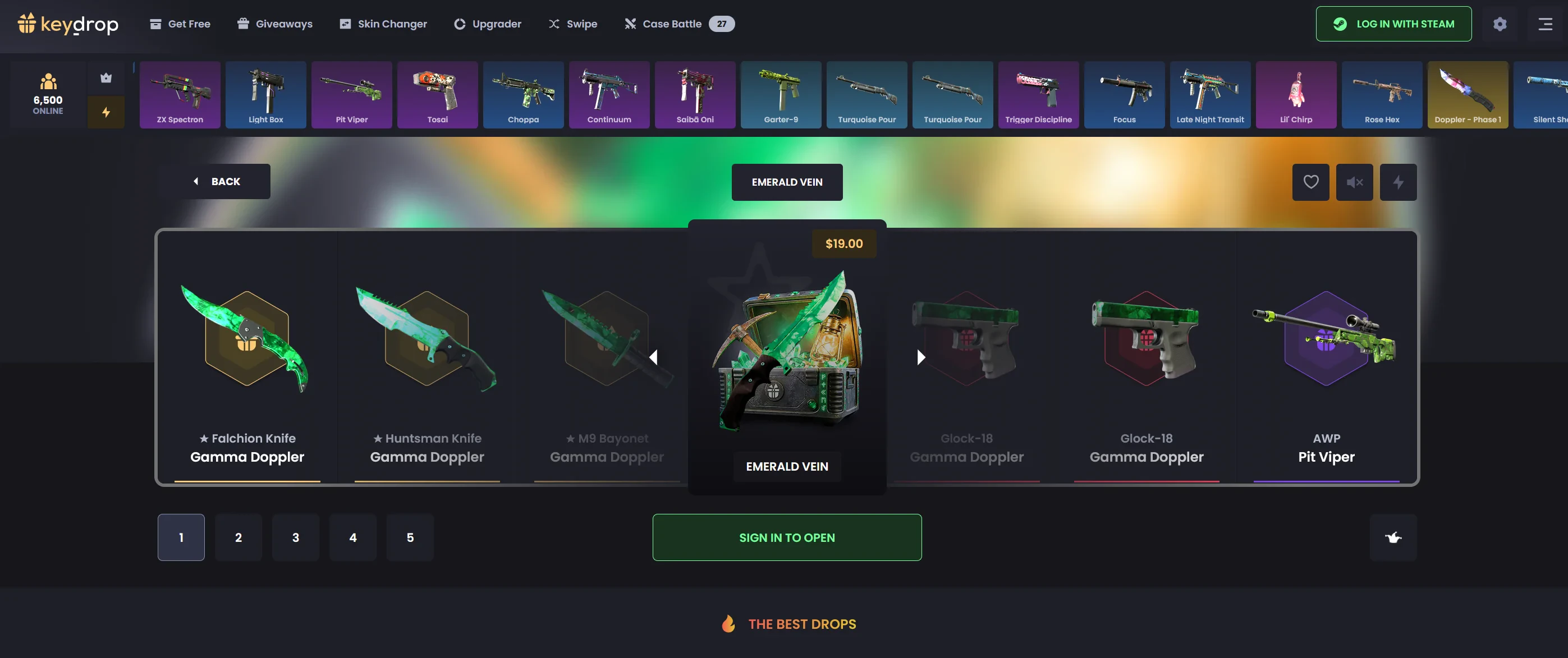
Case opening is the most popular mode on CS2 skin sites and the one people misread most often, because the interface is built around the animation rather than around the number that decides everything: the drop table. A case is a published list of items with published chances, and that list prices the case before you spend anything. Here is how to read one, how site cases differ from Valve's, and what to check before you open — the mode in practice is covered in our CSGOEmpire review.
Valve cases versus site cases
They look alike and are not the same product.
A Valve case drops in game and needs a key bought from Steam. Its odds are fixed and published by Valve in the client, by rarity tier:
| Tier | Chance | Roughly |
|---|---|---|
| Mil-Spec (blue) | 79.92% | 4 in 5 |
| Restricted (purple) | 15.98% | 1 in 6 |
| Classified (pink) | 3.20% | 1 in 31 |
| Covert (red) | 0.64% | 1 in 156 |
| Rare special (knife or gloves) | 0.26% | 1 in 385 |
Whatever you unbox this way follows Valve's rules: a trade cooldown of about a week, and a Steam Market that takes its own cut when you sell.
A site case is not a Valve case. It is a lottery the site designed: it picks the item list, the chances and the price, and pays out of its own skin inventory. That is not automatically worse — the drop can be a knife rather than a blue, and there is no key to buy — but the odds are the site's own, and the only reason to trust them is a verification page you can actually use.
Reading a drop table
Every site case shows each item and its chance. Multiply the chance by the item's real market value, add the rows up, and you have the case's expected value: what an average opening returns. An illustrative $10 case:
| Item | Chance | Market value | Contribution |
|---|---|---|---|
| Knife | 0.30% | $400 | $1.20 |
| Covert rifle | 2.00% | $90 | $1.80 |
| Classified skin | 8.00% | $25 | $2.00 |
| Restricted skin | 25.00% | $8 | $2.00 |
| Mil-Spec skin | 64.70% | $2 | $1.29 |
| Total | 100% | $8.29 |
That case returns about 83 cents per dollar, and the missing 17% is the house edge. The figures above are invented for the example, but the shape is not: most site cases sit between 85% and 95% return, and the ones advertising a headline knife tend to sit at the bottom of that range, because the knife has to be paid for out of the same pot.
Two traps in the arithmetic:
- Value items at market price, not site price. A site listing a skin at $25 when it sells for $18 has inflated its own expected value by a third.
- The median is not the mean. In the table above the average is $8.29, but roughly two-thirds of openings return a $2 skin. The mean is carried by outcomes you will almost never see.
Case battles change the variance, not the edge
A case battle opens the same cases simultaneously for two or more players, and the higher total value takes everything. The edge per case is unchanged — the same cases at the same return — but the outcome becomes winner-takes-all, so variance roughly doubles while expected value stays put, minus whatever the site charges on the battle itself. Battles are a faster route to the same expectation, which is exactly why sites promote them.
Upgraders and contracts
An upgrader takes a skin you own and offers a percentage chance to swap it for a better one. It is presented as a way to climb, and it is priced like everything else on the site: the chance offered is always a little worse than the value ratio between the two skins. Contracts, which trade several items for one of a higher tier, work the same way. Neither recovers a losing session; each is another round at the same edge.
Check the draw, then check the exit
Provably fair works for cases exactly as it does for jackpot: the site publishes the hash of a secret server seed before the roll, mixes in a client seed you can change, then reveals the seed so you can recompute the result. Do it once on any site you plan to use. A site with no verification page has no claim to the odds it prints.
Then check the part provably fair says nothing about:
- Withdrawal minimums. Some sites will not release a skin below a floor value, which turns a run of small drops into a balance you cannot take out.
- Inventory availability. If the exact skin is out of stock you may be offered coins instead, valued at the site's price rather than the market's.
- Payout speed. Fifteen minutes and three days are both "instant" in marketing copy. Our reviews record what each site actually does — Key-Drop and CSCase are two worth comparing on that alone.
- Promo codes are not free cases. A bonus that needs a deposit and carries a wagering condition is a discount on the edge, not an escape from it.
The short version
Read the drop table, price the items at market, and treat the gap between the case price and its expected value as the fee you are paying for the animation. If a site publishes no odds, no seeds, or no market-honest prices, nothing else about it matters. If it publishes all three, you at least know what the game costs — which, on a mode built to feel like a lottery win, is the whole skill.