

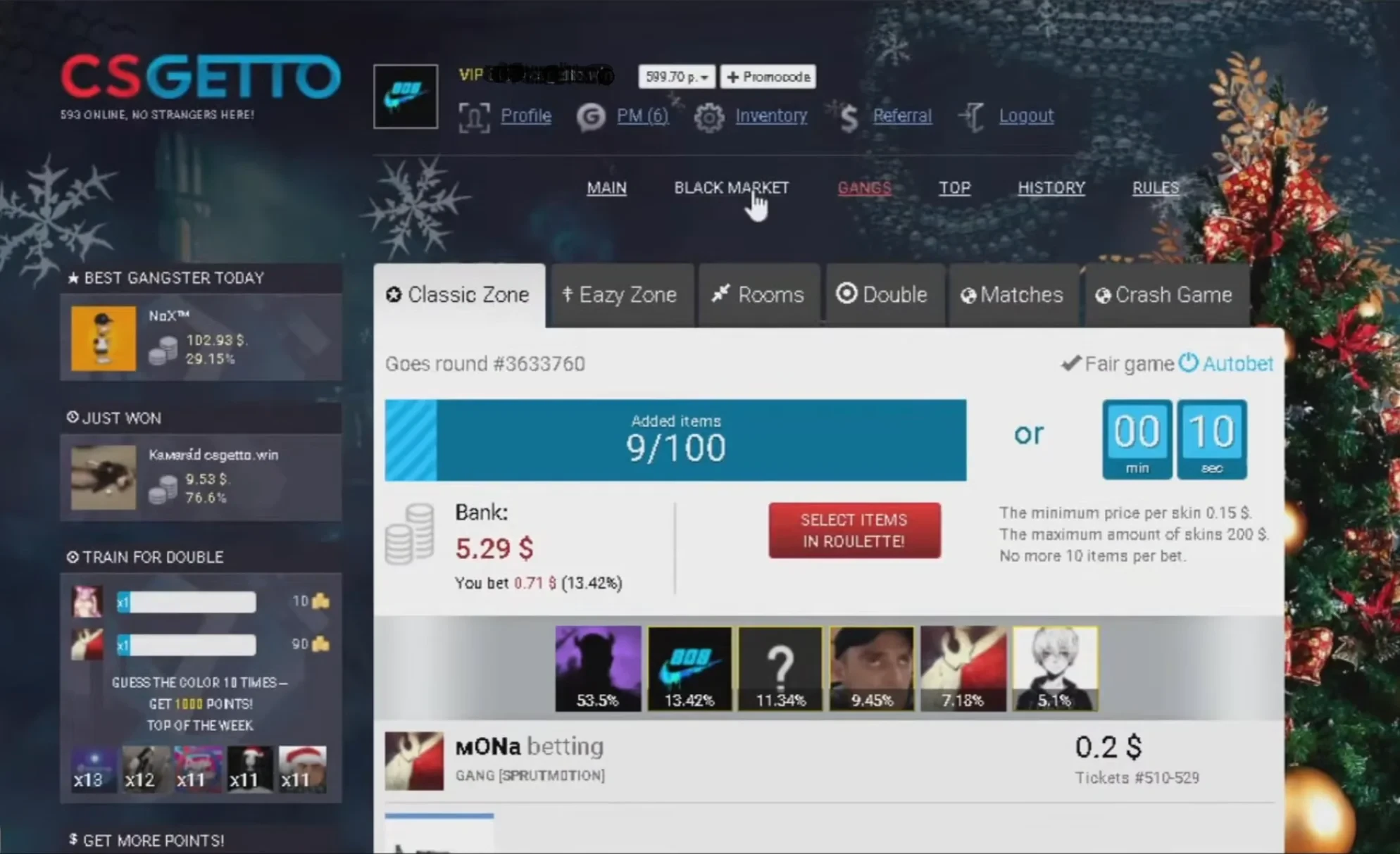
Most sites from this era ran one mode well. CSGetto ran almost everything — and it kept running it for a decade after the rest of its generation had gone. It closed in 2026, and unlike almost every site in this archive, it said goodbye properly.
What it actually offered
The line-up, recorded by code trackers and review pages while the site was live, was unusually broad for a skin site:
- Mega Wheel — its roulette, renamed after a multiplier feature was added. Fifteen slots numbered 0–14, split across colours in the usual way.
- Crash — with an auto-cashout the site itself recommended, because the game was sensitive to latency. That recommendation tells you something: on a laggy connection, manual cash-outs were losing money to the network rather than to the odds.
- Minesweeper — a 5×5 grid where you picked 1, 3, 5 or 24 bombs. Twenty-four bombs on twenty-five tiles is a one-in-twenty-five shot dressed as a skill game.
- Dice — a single die: a straight number paid 5×, high or low paid 1.8×.
- Jackpot — pooled pots, split into three rooms by stake.
- Match betting — sports and esports markets alongside the casino.
Money came in through G2A Pay (card or PayPal), Skrill, gift cards and crypto — Bitcoin, Litecoin, Ethereum, Tether and Monero. It went out as CS:GO skins through a dedicated marketplace. Transferring coins between accounts was explicitly banned in the site's own FAQ, which is a standard anti-laundering rule and a useful signal that someone was paying attention to compliance.
What is on the record about the end
The old domain now forwards to a single page carrying the operator's own farewell: "Игра окончена. Спасибо, что были с нами. 2015 — 2026" — game over, thank you for being with us. That one line settles two things nothing else in this archive settles: the site ran for eleven years, and its operator chose to close it deliberately rather than let it disappear mid-session. No reason is given, and nothing is said about balances, but a posted ending is more than CSGOAtse, CSGOSpeed or SkinBet got.
Reviews from its active years described it as licensed under Curaçao law — a claim we could not verify against any register, and one worth treating carefully: in this industry "licensed in Curaçao" was often a line in a footer rather than a document.
Its promo codes outlived it
Here is the part worth knowing even if you never played there. Months after the site went, code pages were still publishing "CSGetto promo codes for August 2026" — because an affiliate page earns whether or not the operator exists, and nobody audits a dead listing. Other trackers had already flipped the brand to inactive. If two sources disagree about whether a site is alive, the one with a working login page wins; a promo page is not evidence of anything.
What it says about the model
CSGetto did the things that are supposed to keep a site alive: many modes, several deposit rails, a documented fairness system, an FAQ with real rules in it. It still went. Breadth does not protect a skin site — the failure points are upstream, in Steam's trade policy and in the payment processors, and no amount of game development fixes either.
The practical read-across: judge a site by how easily value leaves it, not by how many things there are to play. A casino with nine modes and one withdrawal route is more fragile than a plain case site with three.