

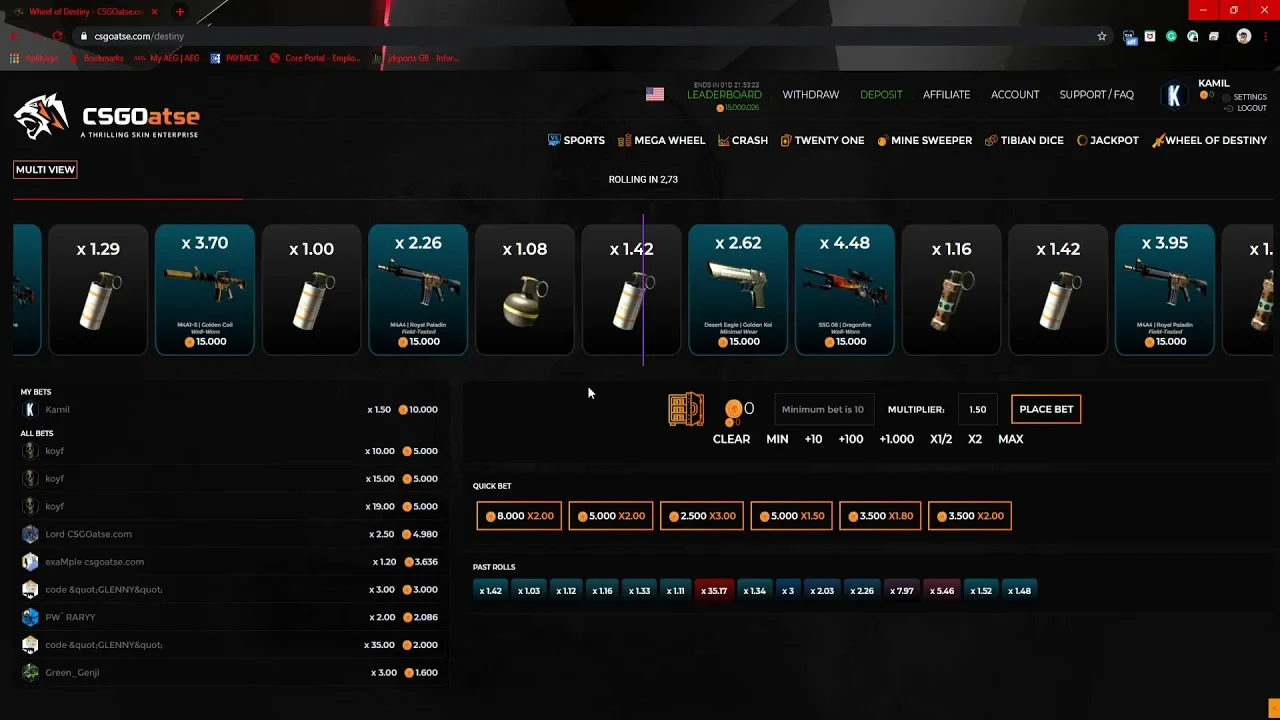
CSGOAtse was one of the names everybody in CS:GO skin gambling knew. It ran the standard set of the era — jackpot, roulette and coinflip — you signed in with Steam, you staked skins rather than money, and the pot paid out in items. That formula was the entire industry for a while, and Atse was near the front of it.
The era it belonged to
To understand any closure from this period you have to start with July 2016, when Valve sent cease-and-desist letters to 23 skin-betting sites for using Steam accounts to run gambling operations — and CSGOatse was named on that list, alongside CSGOLounge, CSGOFast, CSGO500, CSGOWild, CSGOLotto and the rest of the era's biggest names. The letters gave ten days to comply before Valve moved to terminate the accounts the sites depended on. That single move ended some sites within weeks — CSGOLounge stopped skin betting in August 2016 — and pushed the rest into a permanent grey zone where a trade bot could be banned at any moment.
What followed was slower but more decisive: the Washington State Gambling Commission ordered Valve to stop facilitating skin gambling, class-action lawsuits landed and were dismissed, and Steam's trade rules kept tightening. Sites that survived did so by decoupling from Steam's inventory system wherever they could.
What is actually on the record about the closure
Not much, and that is worth stating plainly. What can be verified is that CSGOAtse shut down in 2021 and its domain no longer serves a working site. There is no published statement from the operator explaining why, no regulator action naming it, and no reporting on where user balances went. Anyone telling you the precise reason is guessing.
What we can say is that the pattern is familiar: a site from the 2016 generation kept trading for years after the crackdown, then stopped — quietly, without a wind-down announcement, in the same way most of its contemporaries went.
Why sites like this die
Three pressures killed most of the class of 2016, usually in combination:
- Steam dependence. Every skin site is a guest on Valve's platform. Trade bots get banned, APIs change, and a policy update can break the withdrawal pipe overnight.
- Liquidity. A jackpot site needs a crowd. When traffic falls below the point where pots fill, the mode stops working, and the site stops being worth running.
- Payment rails. Processors drop unlicensed gambling merchants routinely. Losing the deposit route is usually the end, even when players still want to play.
What to take from it
The practical lesson has nothing to do with Atse specifically. On an unlicensed site, your balance is not a deposit — it is a claim on a company with no regulator behind it, and claims like that evaporate on the day the site goes quiet. Three habits follow from that:
- Withdraw on a schedule, not on a feeling. Items in your Steam inventory survive a site closing; balance on the site does not.
- Watch the exits, not the front page. Slowing withdrawals, a thinning skin inventory, support that stops answering and a Trustpilot turning red are all leading indicators. A new promotion is not a counter-signal — it is often what a site does when it needs deposits.
- Never keep a balance you would miss. The end of these sites is rarely announced in advance.